
BECTRA SACF — Stablecoin Accounting & Control Framework

Updated: 1 day ago
RESEARCH & INTELLIGENCE • FRAMEWORK 2026
The SACF provides a seven-pillar method for companies that use stablecoins for payments, treasury management or cross-border activity. It links accounting treatment to the evidence needed to support ownership, control and reconciliation.
ACCOUNTING STARTS WITH THE POSITION ITSELF — Before a balance is recorded, the company should be able to identify the token, the rights attached to it, the entity controlling the wallet or account, and the route from the on-chain position to the ledger.
A stablecoin position can affect more than payment processing. Depending on how the token is issued and used, the company may need to address accounting classification, measurement, legal rights, custody arrangements, access controls and financial reporting.
SACF PRINCIPLE — Establish the facts and the supporting evidence before determining the accounting treatment.
Why stablecoins require a specific review
Two tokens that both target one US dollar can still expose a company to different risks. The relevant issuer, redemption terms, reserve arrangements, regulatory status, supported networks, smart-contract controls, custody model and conversion routes may not be the same.
The accounting analysis therefore starts with a description of the position: what the company holds, why it holds it, the rights it can exercise and the way the position is controlled and evidenced.
The seven SACF pillars
01 — CLASSIFICATION
The review begins by identifying the stablecoin, the issuing entity, the relevant legal entity, the networks and smart contracts in use, the rights attached to the token, redemption terms, reference currency, stabilisation mechanism and applicable regulatory classification.
02 — PURPOSE & EXPOSURE
The company should document why the token is held and the resulting exposure. A payment balance, a treasury position, collateral and a trading position are not the same economic use and should not be analysed as if they were.
03 — ACCOUNTING & MEASUREMENT
Once the position is understood, the accounting analysis addresses recognition, classification, initial measurement, subsequent measurement, presentation and the disclosures required for the reporting framework in use.
04 — OWNERSHIP & EVIDENCE
A recorded balance needs evidence of existence and control. The company must be able to connect the legal entity to the relevant wallet or custodial account, demonstrate the applicable control rights and reconcile the observable position to the accounting records.
05 — COUNTERPARTY & INFRASTRUCTURE
The review also identifies the dependencies that could affect access to or conversion of the position: issuer, redemption process, reserve structure, custodian, trading or payment platforms, blockchain networks and available alternatives if one route becomes unavailable.
06 — GOVERNANCE & CONTROL
The control framework should specify who can initiate, approve and execute movements. Key management, MPC or multisignature arrangements, segregation of duties, limits, whitelists, address and network checks, backups, recovery procedures and incident handling all form part of that assessment.
07 — RECONCILIATION & REPORTING
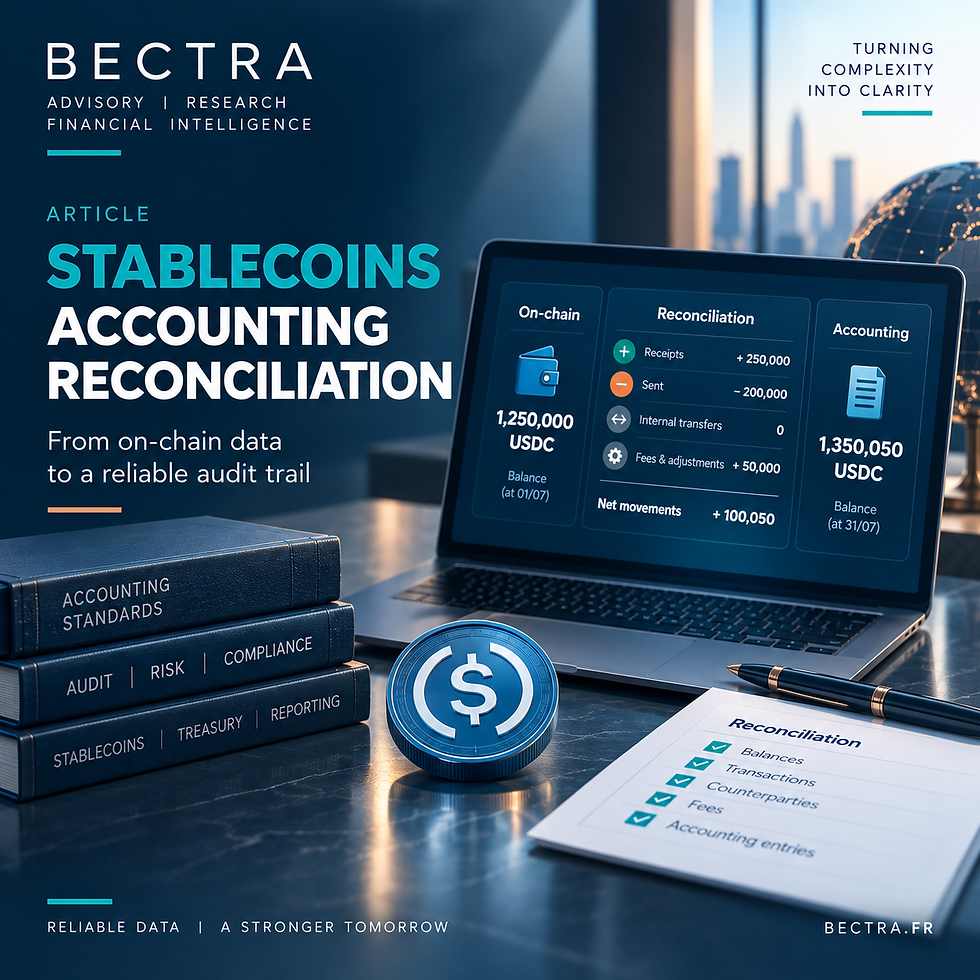
For a material transaction, the audit trail should allow a reviewer to move from the wallet or custodian record to the underlying business transaction, supporting documentation, journal entry, general ledger and financial statements.
Regulatory and tax considerations
MiCA • provider status • AML/CFT • sanctions • transfer rules • corporate tax • VAT • documentation requirements
These matters do not sit outside the accounting analysis. A regulatory or tax issue can change how the token is classified, held, used or documented, and may therefore affect the accounting conclusion.
The French accounting context in 2026
On 9 January 2026, the Autorité des normes comptables (ANC) adopted Regulations No. 2026-01 and No. 2026-02 on crypto-assets. Regulation No. 2026-01 concerns entities applying the French General Chart of Accounts, while Regulation No. 2026-02 concerns the banking sector. Both regulations were approved by an order dated 12 August 2026, published in the French Official Journal on 3 September 2026. Regulation No. 2026-01 is mandatory for financial years beginning on or after 1 January 2027 and may be applied early under the conditions set out in Article 6.
Regulation No. 2026-01 also shows why the analysis cannot begin with a journal entry alone. Depending on the facts, the accounting treatment may turn on the rights represented by the crypto-asset and on how the entity intends to use it. The SACF addresses a wider set of questions around corporate stablecoin use and is not intended to reproduce the regulation.
Questions the documentation should answer
Which stablecoin is held? Which entity, if any, owes the company a redemption or other contractual right? Can that right be exercised in practice? What business purpose does the position serve? What is the maximum exposure? Who can move the assets? What evidence links the balance to the company? Can each material transaction be reconciled to the underlying business event and accounting entry?
The corporate stablecoin control chain
Access to a corporate stablecoin position depends on several links: the issuer and redemption process, the reserve structure, the blockchain, the custody arrangement, transaction controls and the accounting process. A failure at any one of these points can affect availability, conversion, evidence of ownership or the reliability of reported balances.
An on-chain balance is not proof of ownership
A blockchain can show the balance held at an address. It does not, by itself, identify the legal entity that controls the address, establish the corresponding economic rights or confirm that the balance has been recorded correctly. The reconciliation should therefore establish continuity between the on-chain position, effective wallet control, the company’s rights and the accounting record.
Scope and limitations
BECTRA SACF is a research and structuring framework. It is not an accounting or auditing standard, does not determine the legal classification of a stablecoin automatically and does not constitute tax advice. Where professional judgement or a regulated opinion is required, the framework is not a substitute for that work.
Further SACF publications and tools
The SACF is developed through seven complementary publications, each dedicated to one pillar of the framework and connected to the other dimensions of the analysis.
Primary sources
Autorité des normes comptables — ANC Regulations No. 2026-01 and No. 2026-02, 9 January 2026.
Autorité des normes comptables — 14th General Conference on Accounting Research, 10 April 2026, “Crypto-assets: current developments, issues and standard-setting”.
Regulation (EU) 2023/1114 of the European Parliament and of the Council of 31 May 2023 on markets in crypto-assets (MiCA).
BECTRA SACF — Stablecoin Accounting & Control Framework • Version 1.0 • 2026.


Comments