Your Bank Is Asking About the Source of Your Stablecoin Funds: How Should You Build the Evidence File?

A company receives USDC from a customer, transfers the tokens to a crypto-asset service provider, converts them into euros and withdraws the funds to its bank account. A few days later, the bank asks the company to explain the source of the funds.
What evidence should it provide?
A transaction hash or a wallet screenshot will rarely explain the whole transaction. The practical objective is to build a coherent evidence chain from the underlying economic event to the final banking movement.
Invoices or contracts, counterparty information, on-chain transactions, wallets, platform statements, fiat conversion records and bank movements should be reconciled whenever they form part of the transaction.
The objective is not to accumulate documents. It is to enable a third party to understand where the value came from, why the transaction took place, how the funds moved and where they ultimately went.
Your bank has asked for evidence: where should you start?
Start by gathering five groups of information:
1. The underlying economic transaction Invoice, contract, financing or other event explaining why the company received or held the stablecoins.
2. The counterparty Customer, supplier, investor, related company or other party to the transaction.
3. The on-chain transactions Wallets, token, network, amounts, dates and transaction hashes.
4. Movements through the crypto service provider Deposits, conversions and withdrawals when a CASP, exchange or other platform is involved.
5. The banking movement The corresponding fiat inflow or outflow.
The next step is to connect these elements chronologically, rather than sending them as unrelated files.
Why can a bank ask about the source of funds?
Financial institutions subject to anti-money laundering and counter-terrorist financing requirements must apply risk-based customer due diligence measures.
In France, Article L.561-10-2 of the Monetary and Financial Code provides for enhanced examination of certain particularly complex, unusually large or economically unexplained transactions. In those circumstances, the institution seeks information including the source and destination of funds, the purpose of the transaction and the identity of the beneficiary.
This does not mean that every bank must request a dedicated file for every stablecoin transaction. The checks depend on the transaction, its context and the institution's risk assessment.
However, crypto source-of-funds questions can arise when stablecoins are used, particularly where several systems are involved: blockchain, self-hosted wallet, crypto service provider, conversion and banking rails.
The question is therefore not only:
“Does this transaction exist on-chain?”
It is broader:
“What economic event explains this flow, and can its path be reconstructed?”
Source of Funds and Source of Wealth are not the same thing
Source of Funds (SoF) concerns the origin of the funds used or received in a specific transaction or relationship.
Source of Wealth (SoW) looks more broadly at how a person or organisation accumulated its overall wealth or resources.
For a particular stablecoin flow that must be explained to a bank, reconstructing the source and path of the funds will generally be central to the evidence exercise.
Depending on the context and risk assessment, a bank or another regulated entity may request additional information.
A transaction hash does not prove the economic source of funds
An on-chain transaction is valuable evidence.
Its hash can identify information recorded on the relevant blockchain, such as the addresses involved, token, amount, timestamp and transaction status.
But that information does not necessarily establish:
why the stablecoins were transferred;
which commercial or financial event generated them;
who the economic counterparty is;
why the destination wallet belongs to or is controlled by the company;
which invoice or contract the payment relates to;
how the stablecoins were converted into fiat;
why a particular amount ultimately appeared in the bank account.
Three dimensions should therefore be distinguished:
On-chain evidence ≠ economic evidence ≠ banking evidence.
A structured evidence file seeks to connect all three.
For more on linking a wallet or account to the legal entity, see SACF-04 — Ownership & Evidence.
Reconstruct the complete stablecoin flow
1. Identify the economic event
Why were the stablecoins received or transferred?
Examples include settlement of a customer invoice, supplier payment, financing, an intercompany transaction or conversion of an existing treasury position.
The relevant supporting document depends on the transaction: invoice, contract, agreement, internal decision or another appropriate record.
2. Identify the counterparty
Determine who is economically involved in the transaction.
A blockchain address and the person or company with whom the business relationship exists are not necessarily identified in the same way. Where relevant and available, the file should connect the transaction to the counterparty concerned.
3. Document the on-chain movement
For each significant transaction, useful information may include:
the stablecoin;
the network;
originating address;
destination address;
amount;
date and time;
transaction hash;
associated fees.
4. Document the crypto service provider
When stablecoins are transferred to a crypto-asset service provider (CASP), exchange or other platform before conversion, another documentary layer appears.
The company may need to reconcile:
wallet → platform deposit → conversion → fiat balance → withdrawal.
5. Reconcile the bank movement
The withdrawal from the platform should be connected to the movement actually recorded on the bank account.
Dates, amounts, references and any differences should be explainable.
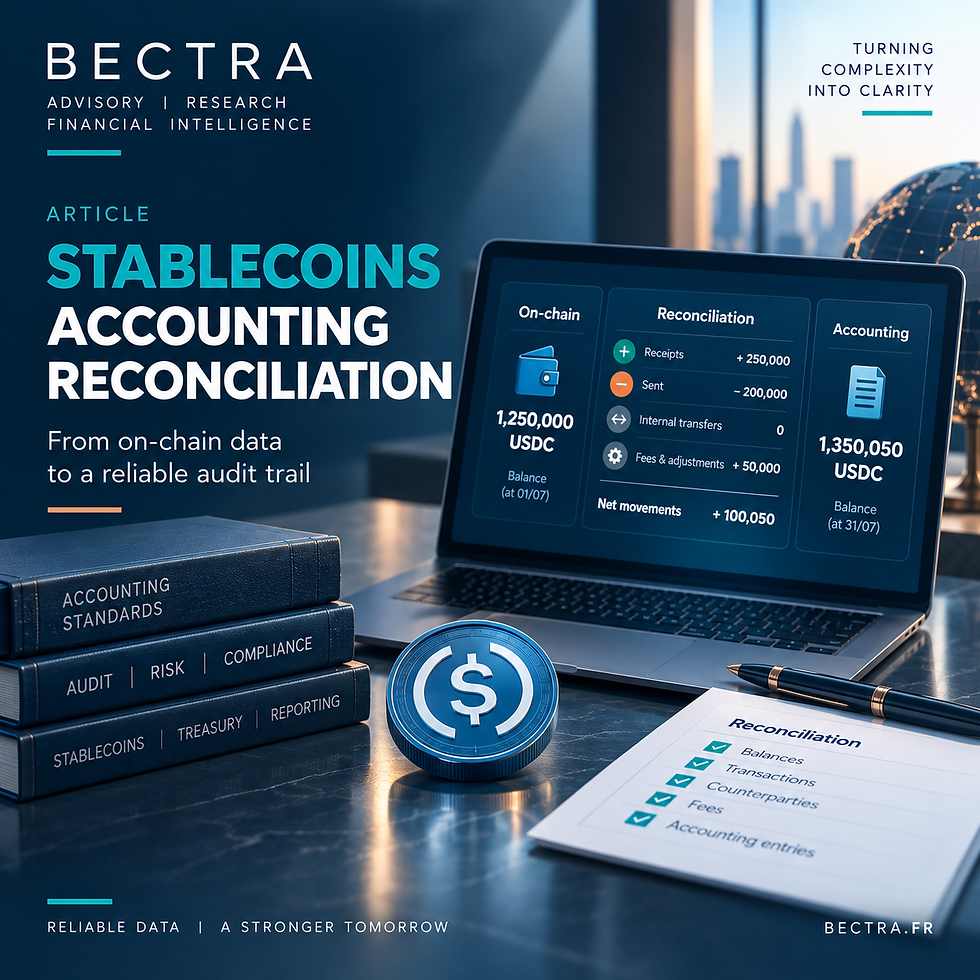
6. Reconcile the flow with accounting
The evidence chain should also remain consistent with the company's accounting records.
A file may be technically consistent on-chain while still containing an accounting anomaly if amounts, dates or counterparties do not match the books.
Differences caused by fees, conversions, FX, internal wallet transfers or period-end cut-off should therefore be identified and explained.
For more on this process, see SACF-07 — Reconciliation & Reporting.
What documents can support a stablecoin source-of-funds file?
There is no universal list of documents that every bank must request or accept in every case.
Relevant evidence depends on the source of funds, the transaction and the institution's request.
Evidence of the economic transaction
Depending on the case:
customer or supplier invoice;
contract;
purchase order;
loan agreement;
financing or capital contribution documents;
internal decision;
another record explaining the economic rationale.
Crypto transaction evidence
Depending on the infrastructure:
transaction hash;
wallet address;
transaction history;
transaction export;
custodian or platform statement;
deposit or withdrawal record.
Banking evidence
For example:
bank statement;
credit advice;
wire transfer evidence;
movement funding the original stablecoin acquisition;
fiat withdrawal following conversion.
Evidence concerning the parties
Depending on the circumstances:
counterparty identity;
company information;
contract or invoice establishing the business relationship;
records linking a wallet to the company where relevant.
Regulated crypto platforms publish examples of documents that may be used in their own source-of-funds procedures, including Coinbase and Kraken.
These examples illustrate documentary logic. They do not constitute a universal list that all banks must request or accept.
Practical example: a customer settles an invoice in USDC
Consider a simplified example.
A French company invoices a customer for €50,000 of services. The parties agree to settle in USDC.
The USDC is received in a wallet controlled by the company, transferred to a CASP, converted into euros and withdrawn to the company's business bank account.
The evidence chain can be represented as:
Customer invoice → counterparty → USDC transaction → company wallet → CASP deposit → USDC/EUR conversion → euro withdrawal → bank account → accounting records
Each stage should be connected to relevant evidence: invoice or contract, counterparty information, transaction hash, on-chain history, CASP statement, conversion record, bank statement and accounting documentation.
A screenshot stating “50,000 USDC received” tells only a small part of the story.
Self-hosted wallets: why control evidence can matter
A self-hosted wallet introduces a specific question:
Who actually owns or controls the address?
Regulation (EU) 2023/1113 sets information requirements for certain transfers of crypto-assets, including situations involving self-hosted addresses when a crypto-asset service provider is involved.
For certain transfers exceeding €1,000 to or from a self-hosted address, the Regulation requires the CASP to take adequate measures to assess whether that address is owned or controlled by the relevant originator or beneficiary.
This provision concerns the CASP's regulatory obligations. It does not, by itself, create a universal list of documents that every company must provide to its bank.
It nevertheless illustrates why the connection between a blockchain address and the person controlling it can become important.
The EBA Travel Rule Guidelines, applicable since 30 December 2024, provide further guidance on information accompanying transfers and the procedures expected from providers.
Ten mistakes that weaken an evidence file
Providing only the transaction hash.
Providing only a wallet screenshot.
Failing to explain the economic event behind the flow.
Failing to identify the counterparty when relevant.
Failing to document the connection between the wallet and the company.
Sending numerous files without a reconciliation table.
Failing to reconcile dates and amounts.
Ignoring conversions and intermediary fees.
Leaving differences between blockchain, platform, bank and accounting unexplained.
Waiting months before reconstructing the evidence.
A strong file is not necessarily the file with the most documents.
It is the file in which each piece of evidence has an identifiable purpose and fits into a comprehensible chain.
BECTRA checklist — Stablecoin Banking Evidence Chain
For a significant stablecoin flow:
☐ The underlying economic transaction is identified.
☐ The counterparty is identified where relevant.
☐ Commercial, financial or legal supporting documentation is available.
☐ The stablecoin and network are correctly identified.
☐ The originating address is documented.
☐ The destination address is documented.
☐ The transaction hash is retained.
☐ The connection between the wallet and the company is documented where necessary.
☐ CASP or platform movements are retained.
☐ Stablecoin/fiat conversion is documented.
☐ The corresponding bank movement is reconciled.
☐ The accounting treatment is reconciled with the transaction.
☐ Any differences are identified and explained.
The BECTRA Stablecoin Banking Evidence Chain is not a regulatory checklist and does not guarantee that a bank will not request additional evidence. It is a documentary organisation method proposed by BECTRA.
Should companies wait for a bank request?
For a one-off transaction, reconstructing evidence after the event may still be manageable.
The situation changes when activity becomes recurrent.
Multiple wallets, networks, conversions, internal transfers, platforms, network fees and banking movements can quickly make reconstruction difficult.
Companies with regular or significant stablecoin flows therefore benefit from organising their documentation as transactions occur.
The objective is not to build a complete banking file for every transaction. It is to retain sufficiently structured information to reconstruct the transaction when necessary.
When does the file become complex?
Complexity increases when a company uses several wallets or blockchains, several CASPs, internal wallet transfers, successive conversions, several fiat currencies, extensive transaction histories, incomplete historical records or flows that do not immediately reconcile with accounting.
A bank request covering several months or several transaction chains may also require a genuine reconstruction exercise.
At that point, the task is no longer simply to collect documents.
It is to reconstruct, reconcile and document the path of the funds.
Turn transactions into an evidence trail that a financial third party can understand
Blockchain provides valuable traceability. But visibility of an on-chain movement does not necessarily explain its economic substance.
For a company, the challenge is therefore to connect:
the economic event, counterparty, wallet, blockchain, crypto service provider, bank and accounting records.
Moving from technical data to an evidence trail that a financial third party can understand makes stablecoin flows easier to explain and substantiate.
Stablecoin Banking Evidence — BECTRA
BECTRA helps companies structure the documentary evidence supporting their stablecoin flows: transaction mapping, organisation of supporting records, reconciliation between economic events, wallets, platforms and bank movements, identification of differences and preparation of a structured evidence package.
BECTRA structures and analyses financial and transactional documentation. This service does not replace compliance controls performed by a bank or crypto-asset service provider, nor legal advice where required.


Comments