SACF-07 — Reconciliation & Reporting: how can companies ensure that blockchain, wallets and accounting tell the same story?

Updated: Aug 29
RESEARCH & INTELLIGENCE • SACF 2026
BECTRA SACF — Stablecoin Accounting & Control Framework • Pillar 7 of 7 • Reconciliation & Reporting
01 Classification → 02 Purpose & Exposure → 03 Accounting & Measurement → 04 Ownership & Evidence → 05 Counterparty & Infrastructure → 06 Governance & Control → 07 Reconciliation & Reporting
Your accounting records show €2.4 million in stablecoins. The wallet shows a different amount. The service provider statement shows a third number. Which one is correct?
This is precisely the problem addressed by the seventh pillar of BECTRA SACF: Reconciliation & Reporting. After determining what the company holds, why it holds it, how it accounts for it, how ownership is evidenced, which counterparties and infrastructures it depends on, and who can act on its positions, the remaining task is to verify that operational, on-chain and accounting data actually converge.
SACF PRINCIPLE — An accounting balance is reliable only if it can be linked to an identifiable, explained, reconciled and reviewed position.
Three reconciliations, three different questions
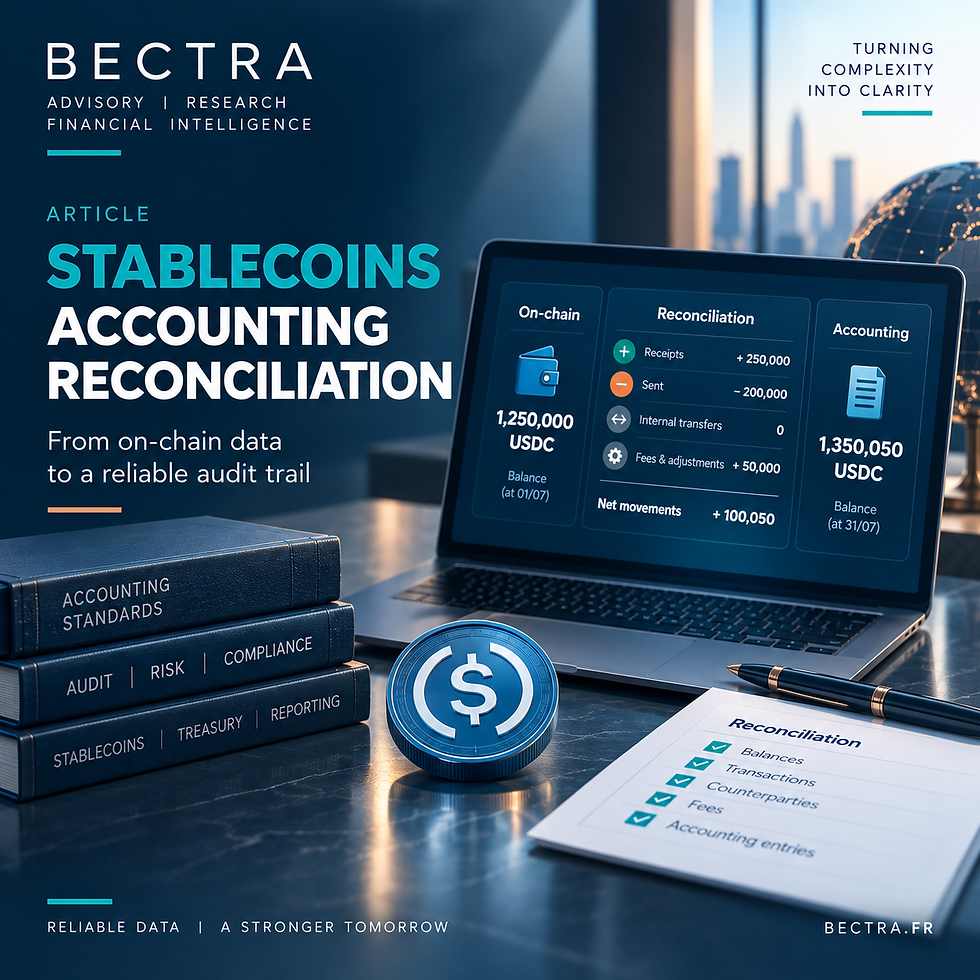
Stablecoin reconciliation is not simply a comparison between a wallet balance and the general ledger. It operates at three levels: position, movements and accounting. A correct position does not prove that all movements were recorded correctly, and complete movements do not prove that the accounting treatment is correct.

1. Define the perimeter before opening the general ledger
The first risk is to reconcile only what the accounting system already knows. The perimeter should instead be established independently of the general ledger and identify at least: stablecoin + issuer + network + wallet or account + legal entity. Where relevant, it may also include token contract, custodian, technical accounts, smart contracts or intermediary platforms.
Two positions using the same ticker should not automatically be treated as one homogeneous operational position.
SACF CONNECTION — SACF-01 provides the classification attributes reused here: token, issuer, network and, where relevant, token contract.
2. Make several sources converge
Matching figures are not necessarily probative reconciliation. If an internal sub-ledger is populated by a service-provider API and then compared with that same API, both figures may match while reproducing the same underlying error.
SACF RULE — A reconciliation is stronger when it compares sources with distinct origins and production methods.

3. Reconcile positions
For each significant position, the company should be able to explain the path from observable position to internal position to accounting position. Service-provider statements may be useful evidence, but they do not replace the company’s own reconciliation process.
SACF CONNECTION — SACF-04 determines which wallets, accounts and positions can be attributed to the company. SACF-07 then uses that perimeter to reconcile them with accounting data.
4. Explain movements, not only balances
Each significant movement should be linked to an identified economic event: supplier payment, customer receipt, acquisition, redemption, conversion, internal transfer, fee or exceptional transaction.

SACF RULE — Equality of balances never replaces an explanation of movements.
5. Distinguish technical movement from economic event
A transfer between two wallets belonging to the same legal entity may be only an internal movement. A transfer between two companies within the same group, however, still takes place between two separate legal persons and requires accounting and legal analysis.

6. Identify the technical components of the transaction
A stablecoin transaction may include principal, network fees, service-provider fees, spread and other costs. It may also be pending, failed, replaced or delayed. Any difference should be detected, qualified and explained.

7. Formalize cut-off
Blockchains operate continuously while accounting periods close at a defined date. The reconciliation process should document instruction time, on-chain timestamp, provider date, relevant confirmation level and the accounting date ultimately selected.

The blockchain does not automatically take precedence in every case. Neither does the service provider. The selected rule should be justified, consistent and reproducible.
8. Check valuation without repeating SACF-03
SACF-03 defines the accounting and valuation method. SACF-07 checks its proper application and should allow the company to reproduce the chain: source → date → time → price or rate → quantity → conversion → accounting entry.
9. Turn differences into an exception-management process
A strong reconciliation process is not defined by the apparent absence of differences, but by the ability to identify and resolve them. Each significant exception should be tracked by nature, amount, age, owner, target date, status and resolution.

10. Prove that reconciliation was actually performed
Could an independent third party reconstruct the accounting balance from the period-end file without asking the preparer how it was built?
The minimum close file should cover perimeter, balances, movements, cut-off, valuation, exceptions and review.
SACF CONNECTION — SACF-06 defines who prepares, approves and oversees. SACF-07 should provide evidence that those controls were actually performed.
From reconciliation to reporting
Reconciliation data can feed three reporting layers: operational reporting, control reporting, and financial & management reporting.

Reconciliation therefore connects: TREASURY → CONTROL → ACCOUNTING → DECISION.
SACF-07 closes the loop
A company using stablecoins should be able to explain what it holds → why it holds it → how it accounts for it → how ownership is evidenced → which counterparties it depends on → who can act → how positions and movements are reconciled.
Stablecoin reconciliation is therefore not a simple balance comparison. It is the mechanism through which several sources converge toward an accounting position that is explained, documented and reviewed.
Continue through the BECTRA SACF framework
To extend this analysis, the following pillars are the most directly connected to the issues addressed in this article.
Within the BECTRA SACF framework
01 Classification → 02 Purpose & Exposure → 03 Accounting & Measurement → 04 Ownership & Evidence → 05 Counterparty & Infrastructure → 06 Governance & Control → 07 Reconciliation & Reporting


Comments