SACF-01 — Classification: What Does Your Company Actually Hold?

Updated: Aug 29
RESEARCH & INTELLIGENCE • SACF 2026
BECTRA SACF — Stablecoin Accounting & Control Framework • Pillar 1 of 7 • Classification
01 Classification → 02 Purpose & Exposure → 03 Accounting & Measurement → 04 Ownership & Evidence → 05 Counterparty & Infrastructure → 06 Governance & Control → 07 Reconciliation & Reporting
What does the company actually hold?
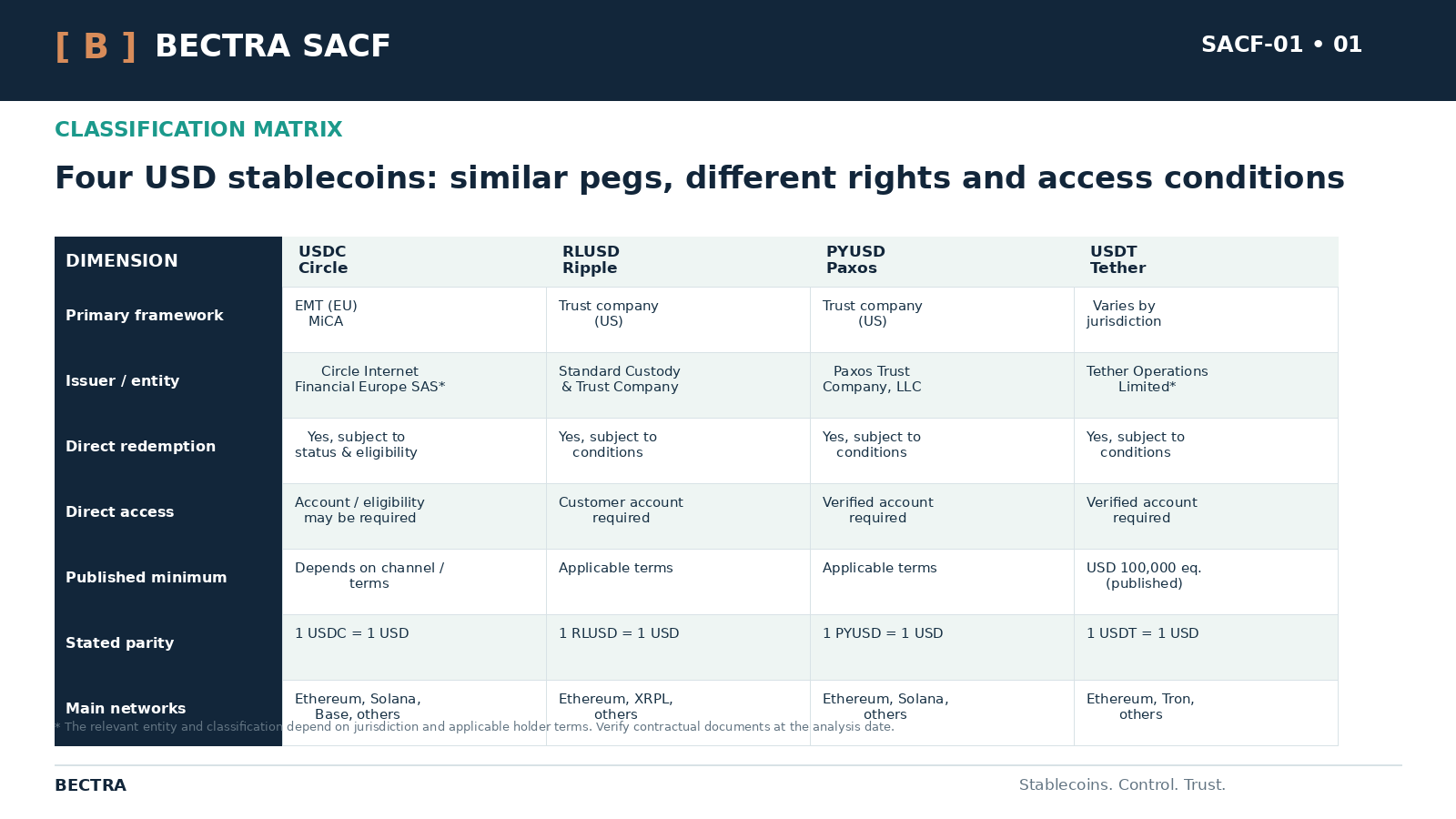
A stablecoin trading around one dollar or one euro should not be treated as the legal or economic equivalent of a bank deposit merely because its market price remains close to par. Classification starts with facts: exact token, issuing entity, attached rights, redemption conditions, regulatory perimeter and infrastructure used.
SACF CONNECTION — Classification is only the starting point: the analysis must then be tied to the business purpose, holding horizon and resulting exposures. SACF-02 explores this point in greater detail.
SACF PRINCIPLE — The displayed token price does not, by itself, determine the nature of the asset held.
1. Identify the exact token
The ticker is not enough. The review should identify the token name, network, contract address where relevant, and any bridged or wrapped version. Assets carrying the same ticker on different networks may have different operational and legal characteristics.
2. Identify the issuer and the entity carrying the obligations
The commercial brand, parent company and legal entity that issues, redeems or owes obligations to the holder should be distinguished. This distinction affects the rights analysis and the applicable jurisdiction.
3. Examine redemption rights
Market stability and redemption rights are different concepts. Document who may redeem, with which entity, subject to what eligibility requirements, minimums, timing, geographic restrictions and verified-account conditions.
SACF RULE — Holding a token that trades around USD 1 does not necessarily mean the holder personally has an immediately exercisable USD 1 redemption claim against the issuer.
4. Identify the relevant regulatory classification
Regulatory classification should be assessed in the relevant jurisdiction and for the relevant issuing entity. In the European Union, MiCA distinguishes in particular e-money tokens and asset-referenced tokens. That classification should not automatically be extended to an issuance or holder outside the EU.
5. Review the stabilisation mechanism and reserves
Reserve composition, liquidity, custody and attestation frequency provide information on the stabilisation mechanism and depeg risk. They do not replace the analysis of the holder's legal rights.
6. Include network and smart contract in operational classification
The asset actually held also depends on network, contract, bridges and token functions. Operational classification should be precise enough for treasury, control and accounting teams to refer to the same asset.
SACF CONNECTION — Classification is an input to accounting: it should be established before the recognition and measurement method is selected. SACF-03 explores this point in greater detail.
7. Accounting comes after this analysis
SACF-01 does not determine the journal entry by itself. It produces the factual file used by SACF-02 to document purpose and by SACF-03 to determine accounting treatment and measurement.
SACF CONNECTION — 01 → 02 → 03: determine what is held, document why it is held, then decide how to account for it.
Continue through the BECTRA SACF framework
To extend this analysis, the following pillars are the most directly connected to the issues addressed in this article.
Within the BECTRA SACF framework
01 Classification — What does the company hold? • 02 Purpose & Exposure — Why does it hold it and what is it exposed to? • 03 Accounting & Measurement — How should it be accounted for and measured? • 04 Ownership & Evidence — How can ownership be demonstrated? • 05 Counterparty & Infrastructure — Which counterparties and infrastructures does it depend on? • 06 Governance & Control — Who can decide, access and act? • 07 Reconciliation & Reporting — How can positions, movements and accounts be shown to remain consistent?


Comments